Taiwan Oolong Tea: The History of Formosa Oolong, High Mountain Tea and Oriental Beauty
Teatentional
Taiwan is about the size of Maryland, yet it produces some of the most celebrated oolong tea in the world. Creamy high mountain oolongs, roasted Dong Ding, and honey-sweet Oriental Beauty all come from this one island. Its tea story begins just across the water, in the oolong country of Fujian, China.
This article is part of our series on the history of tea.
Tea Crosses the Strait
In the 1700s and 1800s, settlers from Fujian province moved across the Taiwan Strait. Many came from Anxi and the Wuyi Mountains, two of the most important oolong regions in China, and they brought tea plants and tea-making skills with them. Records from the late 1700s describe Fujian tea trees being planted in northern Taiwan. Small tea gardens spread across the northern hills.
At first, much of Taiwan's tea was sent back to Fujian to be finished and sold. That changed thanks to a British merchant.
John Dodd and Formosa Oolong
In the 1860s, a British trader named John Dodd came to Taiwan, which Europeans then called Formosa, and saw the potential in its tea. He lent money to farmers to plant more, brought in skilled tea makers from Fujian, and set up tea processing in Taipei so the tea could be finished on the island. In 1869 he shipped a large cargo of "Formosa Oolong" straight to New York.
It was a hit. Formosa Oolong became a popular tea in America in the late 1800s, and the name stuck. Many Taiwanese teas are still sold as "Formosa" today.
Oriental Beauty: The Bug-Bitten Tea
Taiwan's most famous tea owes its flavor to a tiny insect. In summer, small green leafhoppers feed on the tea leaves in the hills of Hsinchu and nearby areas. The bitten leaves react by producing new aromatic compounds. Tea makers learned that if they skipped pesticides, let the insects do their work and then processed the leaves as a heavily oxidized oolong, the result was extraordinary: sweet, fruity and honeyed, with notes of ripe peach and muscat.
The tea is called Oriental Beauty, or Dongfang Meiren. A popular legend says a British queen gave it the name after tasting it, though the story is hard to prove. It is also sold as "white tip oolong" for the silvery buds in the leaf.
High Mountain Oolong
In the 20th century, Taiwanese farmers began planting tea higher and higher into the island's central mountains. At these heights, often above 3,000 feet, cool air, mist and slow growth make the leaves thick, sweet and fragrant. These high mountain oolongs, called gaoshan, are now the most popular oolongs in Taiwan. Famous growing areas include Alishan, Lishan and Shanlinxi.
High mountain oolongs are usually lightly oxidized and rolled into tight balls. In the cup they are floral and buttery, somewhere between a green tea and a classic oolong.
Other Taiwanese Classics
- Dong Ding: grown near Lugu in central Taiwan since the 1800s. Rolled, medium roasted, warm and nutty.
- Baozhong (Pouchong): a lightly oxidized, twisted-leaf oolong from the hills near Taipei. Its name refers to the paper it was once wrapped in.
- Jin Xuan ("milk oolong"): a modern Taiwanese tea variety known for a naturally creamy, buttery taste.
- Taiwanese black teas: grown around Sun Moon Lake, especially since the Japanese era of the early 1900s.
And of course, Taiwan gave the world bubble tea in the 1980s, which started as a sweet iced tea with chewy tapioca pearls.
How to Brew Oolong
Oolong rewards patience. Good oolong can be steeped many times, and the flavor changes from one cup to the next.
- Western style: 1 teaspoon per 8 oz of water at about 190 to 200°F for 3 to 4 minutes. Re-steep 2 to 4 times, adding a minute each time.
- Gongfu style: a small pot, about twice as much leaf, and short steeps of 20 to 40 seconds, many times over.
Rolled oolongs need room to open, so use a pot or infuser with space for the leaves to unfurl. Our 20 oz ceramic teapot and infuser works well. A slow session of re-steeped oolong is one of the best ways to spend a rainy Portland afternoon.
Our Oolong
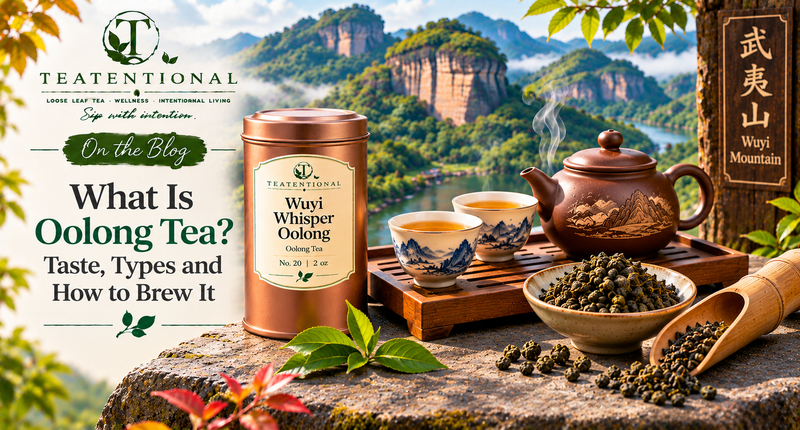
Wuyi Whisper Oolong
Taiwan's oolong tradition began in Fujian, and many of its first tea makers came from the Wuyi Mountains. Our single-origin Wuyi Whisper Oolong comes from those same mountains: earthy, mineral and smoothly roasted, with a flavor that changes over up to 4 steeps. If you love the roasted side of Taiwanese oolong, like Dong Ding, this is the tea for you.
Steep intentionally. Sip with intention.
Related Reading
Go back to the full History of Tea, or keep exploring with Chinese Tea Culture, The 6 Types of Tea Explained and How to Brew the Perfect Cup of Loose Leaf Tea.