Chinese Tea Culture: The History of Tea in China, From Ancient Tombs to Pu'erh
Teatentional
Every type of tea in the world traces back to China. Green, black, white, oolong and pu'erh were all developed there first, and for most of history China was the only place on earth that grew and made tea at all. If you have ever watched a jasmine pearl unfurl in your cup or rinsed a pu'erh before the first steep, you have taken part in a tradition thousands of years old.
This article is part of our series on the history of tea. Here we go deeper into China, where the story begins.
The Legend of Shennong
Chinese tradition credits tea to Shennong, a legendary ruler known as the "Divine Farmer." The story says that around 2737 BC, leaves from a wild tea bush fell into water he was boiling, and he found the drink refreshing. An old herbal text attributed to him describes tea as a remedy. The story was written down long after the time it describes, so it belongs to legend, but it captures something true: in China, tea started as a medicine and a food before it became a daily drink.
What the Archaeology Says
Real evidence of tea in China goes back about 2,400 years. In a tomb in Zoucheng, Shandong province, archaeologists found a small bowl holding charred plant remains. Lab tests published in 2021 showed they were tea leaves left over after boiling or brewing, dated to around 453 to 410 BC.
A few centuries later, tea was buried with an emperor. Burial pits at the tomb of Emperor Jing of Han, who died in 141 BC, held tea made almost entirely of young buds, the best part of the plant. Tea does not grow near the tomb, which tells us it was valued enough to be brought from far away and sent with the emperor into the grave.
The Tang Dynasty: Tea Cakes and The Classic of Tea
During the Tang dynasty (618 to 907), tea spread across China and became part of everyday life. Leaves were steamed, pounded and pressed into cakes that could be stored and carried. To make a drink, you roasted a piece of the cake, ground it to powder and boiled it, sometimes with salt.
This is when Lu Yu wrote The Classic of Tea, finished around 760 to 780. It was the first book in the world devoted entirely to tea. Lu Yu wrote about where tea grows best, how to pick and process it, which tools to use, and why the water matters as much as the leaf. He was so influential that tea sellers later kept small statues of him in their shops.
The Song Dynasty: Whisked Tea
In the Song dynasty (960 to 1279), the fashion changed. Fine tea was ground into a bright powder, whisked with hot water in a dark bowl until frothy, and judged on the color and lasting quality of the foam. Tea contests were popular among the wealthy. This whisked style is the ancestor of Japanese matcha, which monks carried from Song China to Japan. You can follow that thread in Japanese Tea Culture.
The Ming Dynasty: Loose Leaf and the Teapot
The biggest turning point came in 1391. The founding emperor of the Ming dynasty ordered that tea sent to the palace as tribute should no longer be pressed into cakes. Loose leaves would do. Within a few generations, the way China drank tea changed completely. People began steeping whole leaves in water, and the teapot and small teacup became standard. This is the way most of the world still brews tea today.
Loose leaf brewing also pushed tea makers to experiment, and many of the tea types we know took shape in the centuries that followed:
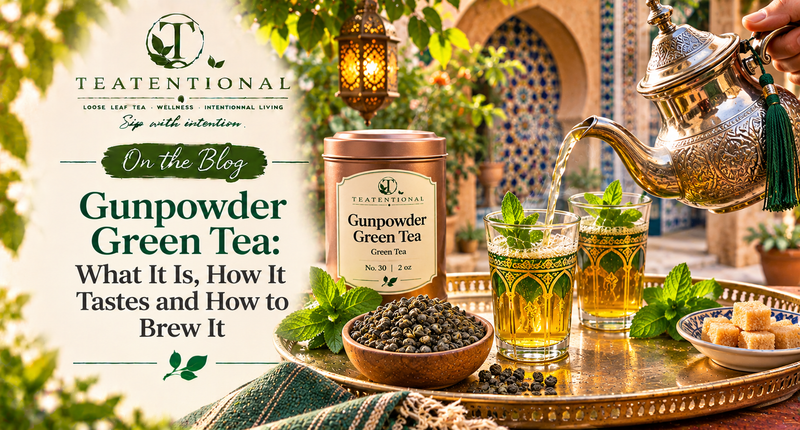
- Green tea: leaves pan-fired in a hot wok to keep them green and fresh. Gunpowder green, rolled into tight pellets, is the base of Moroccan Mint.
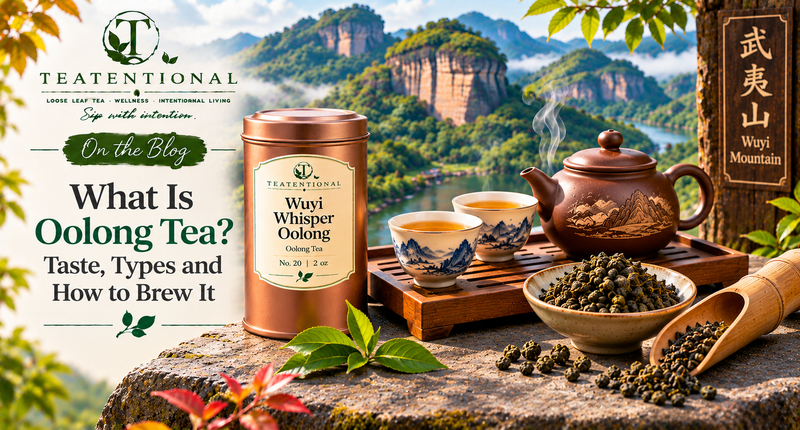
- Oolong: partly oxidized, with roasted, mineral flavors. The Wuyi Mountains of Fujian became famous for "rock teas" grown on stony cliffs.
- Black tea: fully oxidized. Lapsang souchong, from the Wuyi Mountains, is often named as the first black tea. Europeans first knew Wuyi tea by the trade name "Bohea."
- White tea: made mostly from young buds that are simply withered and dried. Fujian province is its home.
- Scented tea: green tea layered with fresh jasmine blossoms until it takes on their perfume. Fujian is also famous for these.
Pu'erh and the Tea Horse Road
Not all Chinese tea went loose. In Yunnan, in China's far southwest, tea kept being pressed into cakes and bricks, partly because it had to travel so far. For centuries, caravans of porters and mules carried tea along mountain trails known as the Tea Horse Road, from Yunnan and Sichuan up onto the Tibetan Plateau. China traded the tea for Tibetan horses, and in Tibet it became butter tea, an everyday source of warmth at high altitude.
This pressed tea from Yunnan is pu'erh, named after the trading town of Pu'er. Over months and years, the tea slowly ferments and changes, growing smoother and deeper. Traditional pu'erh, called sheng or raw, ages naturally. A faster method to make shou or ripe pu'erh was developed in Yunnan in the 1970s. Like a fine wine, a well-aged raw pu'erh is prized, and the best can be re-steeped many times.
Tea and the World
From the 1600s, Chinese tea flowed out to the world by sea. Portuguese and Dutch ships brought it to Europe, and the British East India Company built an empire on it. For two centuries, nearly every cup of tea in London came from China. That ended only when the British smuggled tea plants and know-how out of China and started plantations in India, a story told in Where Does Chai Tea Come From? Even today, China is the world's largest tea producer and drinks most of what it grows.
How to Brew Chinese Tea at Home
Chinese tea culture is built on taking your time. A popular style is gongfu brewing: a small pot or cup, more leaves than usual, and many short steeps, each one tasting a little different from the last. It suits a long, rainy Portland afternoon perfectly. You do not need special gear. A small teapot like our 20 oz ceramic teapot and infuser or a ceramic tea cup infuser works well.
- Use about twice the leaf you would for a mug.
- For pu'erh, rinse the leaves with hot water for about 10 seconds and pour it out.
- Steep for 20 to 30 seconds, pour it all out, and drink.
- Add a few seconds to each steep after that. Good oolong and pu'erh can go many rounds.
Our Chinese Teas
Mengku Iceland Pu'erh Raw Tea
A raw sheng pu'erh from the ancient tea mountains of Mengku in Yunnan, aged 20 years. Earthy, floral and honeyed, with a long finish. Rinse once, then steep in short rounds. It can be re-steeped 8 to 10 times.
Wuyi Whisper Oolong
A single-origin oolong from the Wuyi Mountains of Fujian, the same mountains that gave the world rock tea and the first black tea. Mineral, smooth and lightly roasted. Re-steep up to 4 times.
Tranquil Jasmine Pearl Green
Hand-rolled green tea pearls scented with jasmine. Watch them open in the cup. Steep at 175°F for 2 to 3 minutes.
Blooming Tea
A modern Chinese craft: tea leaves hand-tied around dried flowers that open into a blossom in hot water. Best in a clear glass so you can watch.
Earl Grey Cream Pu'erh
Where China meets the British tea table: earthy pu'erh with cornflowers and a bergamot flavor.
Steep intentionally. Sip with intention.
Related Reading
Go back to the full History of Tea, or keep exploring with Japanese Tea Culture, Does Jasmine Tea Have Caffeine? and The 6 Types of Tea Explained.