Where Does Chai Tea Come From? The History of Chai and Tea in India
Teatentional
Chai is the drink of India. It is poured from big kettles at train stations, sipped from little clay cups on street corners and simmered on the stove in homes across the country. So it may be a surprise that black tea only became an everyday Indian drink about a hundred years ago. The story of how it happened involves wild jungle tea, a British plant smuggler and a crowd of street vendors who refused to follow the rules.
This article is part of our series on the history of tea.
First, a Word on "Chai Tea"
In Hindi and many other languages, chai simply means tea. The word comes from the Chinese cha, which traveled west along overland trade routes. What Americans call "chai" is really masala chai: black tea simmered with milk, sugar and a mix of spices, or masala. So "chai tea" technically means "tea tea," but everyone knows what you mean.
Wild Tea in Assam
The tea plant grows natively in Assam, in India's far northeast, on the edge of the region where tea first grew in southwest China. The Singpho people of the area brewed its leaves long before any outsider took an interest.
In 1823, a Scottish trader named Robert Bruce was guided by Maniram Dewan, an Assamese nobleman, to a Singpho chief who showed him the local tea plants. Bruce died soon after, and his brother Charles kept sending samples to British botanists. It took more than ten years for them to accept that the plant was true tea. Charles Bruce then set up the first tea gardens in Assam, and a shipment of Assam tea was auctioned in London in January 1839. That same year, the first Indian tea company was formed. Maniram Dewan went on to plant his own tea gardens and became one of the first Indian tea planters.
Why Britain Wanted Indian Tea
To understand why the British cared so much, you need to know about their tea problem. By the 1800s, Britain drank enormous amounts of tea, and all of it came from China. China wanted silver for its tea and little else that Britain sold. To pay for it, the British East India Company sold opium grown in India into China, which led to the Opium Wars of 1839 to 1842 and 1856 to 1860. Growing tea inside the British Empire would solve the problem for good.
The Great Tea Heist
Assam tea was a start, but the British also wanted Chinese tea plants and, even more, Chinese know-how. In 1848, the East India Company hired the Scottish botanist Robert Fortune to travel into China's tea districts, which were closed to foreigners. Disguised in Chinese dress, he collected seeds and plants, learned how tea was processed and recruited skilled Chinese tea workers. Using sealed glass cases to keep the plants alive at sea, he sent about 20,000 plants and seedlings to India, many of them to the Himalayan foothills around Darjeeling.
Most of those plants died, but the knowledge and the workers made all the difference. Darjeeling became famous for some of the finest black tea in the world, Assam for strong, malty tea, and the Nilgiri hills of the south for bright, fragrant tea. Before the century was over, India had passed China as the world's largest tea grower. Across the water in Ceylon, now Sri Lanka, the same thing happened after a fungus wiped out the coffee crop. A Scottish planter named James Taylor planted the island's first commercial tea field in 1867, and Ceylon tea soon followed Indian tea to London.
How Chai Was Born
Here is the twist. Nearly all of that tea was shipped to Britain. Most Indians did not drink it, and many thought of tea as a medicine rather than an everyday drink.
In the early 1900s, the British-run Indian Tea Association decided to change that. It ran a huge campaign to build a tea habit at home. It encouraged factories, mines and textile mills to give workers tea breaks, sent demonstrators to show families how to brew it, and supported independent tea sellers along India's growing railway network. The official advice was to make tea the British way, with a little milk and sugar.
The tea sellers, called chaiwallahs, had other ideas. They used more milk and more sugar, and they simmered the tea with spices that Indian kitchens had used for centuries: cardamom, ginger, cinnamon, cloves and black pepper. It stretched the expensive tea leaves further and tasted wonderful. The Tea Association was not happy, because spices meant fewer leaves sold per cup. But customers loved it, and masala chai spread across the country.
Chai Today
India is now one of the biggest tea drinkers in the world, and most of the tea it grows stays at home. Every region and every family has its own way of making chai. Some add fennel or star anise. In the north, chai is often heavily spiced; in parts of the south, many people simply take strong tea with milk. On the street it is still made in a big pot, poured from a height and served in small cups, sometimes in a clay cup called a kulhad that gives the tea an earthy note.
Outside India, chai became a coffee shop favorite as the "chai latte," usually a sweet spiced syrup or concentrate with steamed milk. Here in Portland, it is as much a part of a rainy-day café order as coffee. But the best chai is still the kind you simmer at home with real tea and whole spices. Learn how in How to Make a Chai Tea Latte at Home, and if you are wondering about the buzz, read Does Chai Have Caffeine?
How to Make Simple Stovetop Chai
- In a small pot, bring 1 cup of water to a simmer.
- Add 2 teaspoons of Chai Caramel Loose Leaf Tea and simmer for 2 to 3 minutes.
- Pour in 1 cup of milk or oat milk and bring it back up to a gentle simmer, without boiling over.
- Sweeten with sugar or honey to taste, then strain into cups.
For a quick single cup, steep 1 teaspoon in 8 oz of water at 200°F for 4 to 5 minutes, then add warm milk and honey.
Our Chai Teas
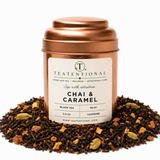
Chai Caramel Loose Leaf Tea
The classic chaiwallah spices on a rich black tea base: cinnamon, ginger, anise, black pepper, cloves and cardamom, with a natural caramel flavor. Bold enough to stand up to milk.
Sweet Apricot Cinnamon Chai
A lighter, modern take on chai, with green tea, warm cinnamon and soft apricot. Steep at 185°F for 3 to 4 minutes and add oat milk if you like it creamy.
Organic English Breakfast Tea
Want to blend your own chai? Start with this bold organic black tea and add your own spices.
Steep intentionally. Sip with intention.
Related Reading
Go back to the full History of Tea, or keep exploring with British Tea Culture, Chinese Tea Culture and How to Make a Chai Tea Latte at Home.